Crowds: level of detail and sprites
Level of detail (LOD) is how the core draws thousands of different avatars in one frame: it does less for the
avatars that are small on screen. It is off until you call sona_lod_set.
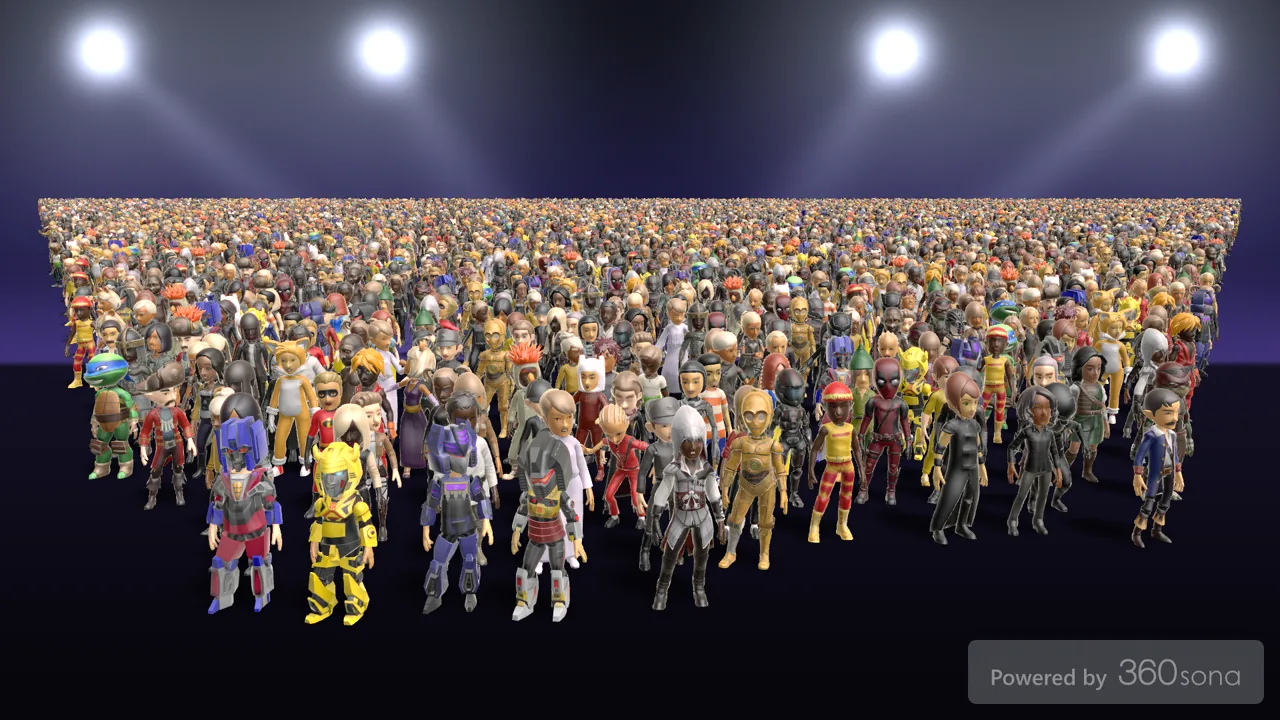
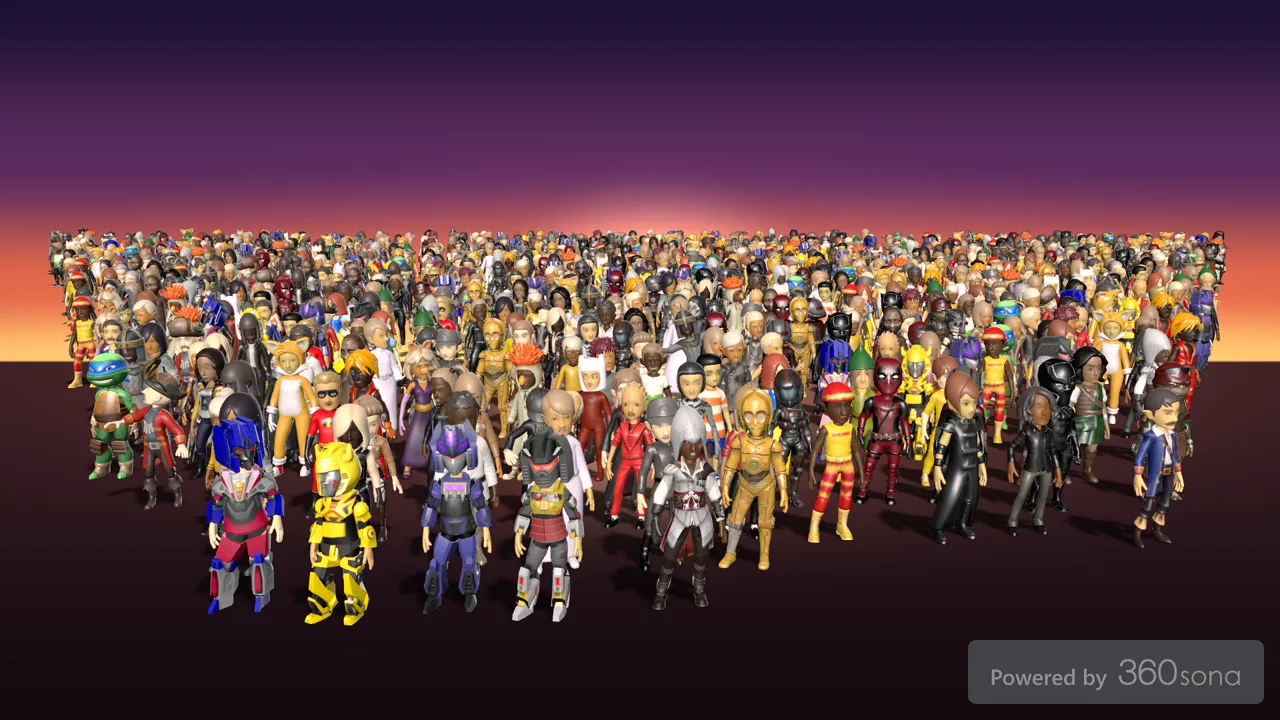
- Avatars near the camera are posed and drawn exactly as without it.
- Avatars further away are posed less often.
- Far avatars become sprites: a picture of the avatar, baked once per look and turn, drawn as one flat textured quad that faces the camera. A sprite is not posed at all.
Avatars cross between a mesh and a sprite over a short crossfade, so nothing pops.
The public API is five functions and two structs (C reference: crowds).
Quick start
sona_ctx *ctx;
sona_config cfg;
sona_config_defaults(&cfg);
cfg.max_avatars = 10000;                 /* up to 16384 */
/* ... sources and licence as usual ... */
if (sona_open(&cfg, &ctx) != SONA_OK) return 1;
/* LOD and sprites on, with the defaults */
sona_lod_set(ctx, NULL);

/* ... add avatars, create a renderer ... */

for (;;) {
  sona_lod_stats st;
  sona_update(ctx, dt, &view, NULL);     /* gives each avatar its step */
  /* bakes new looks, draws meshes and sprites */
  sona_draw(renderer, &view, &target, NULL);
  /* st.sprite avatars were sprites this frame */
  sona_lod_stats_get(ctx, &st);
}
sona::Config cfg;
// up to 16384; sources and licence as usual
cfg.max_avatars(10000);
sona::Context ctx(cfg);
// LOD and sprites on, with the defaults
ctx.set_lod(nullptr);

// ... add avatars, create a renderer ...

for (;;) {
  ctx.update(dt, &view);                   // gives each avatar its step
  // bakes new looks, draws meshes and sprites
  r.draw(view, target);
  // st.sprite avatars were sprites this frame
  sona_lod_stats st = ctx.lod_stats();
  (void)st;
}
// up to 16384; sources and licence as usual
using var ctx = new SonaContext(new SonaOptions { MaxAvatars = 10000 });
// LOD and sprites on, with the defaults
ctx.SetLod();

// ... add avatars, create a renderer ...

for (;;)
{
    ctx.Update(dt, view);                      // gives each avatar its step
    // bakes new looks, draws meshes and sprites
    r.Draw(view, target);
    // st.sprite avatars were sprites this frame
    var st = ctx.LodStats();
}
// up to 16384; sources and licence as usual
let cfg = Config::new().max_avatars(10000);
let ctx = Context::open(cfg)?;
// LOD and sprites on, with the defaults
ctx.set_lod(None)?;

// ... add avatars, create a renderer ...

loop {
    ctx.frame()?.update(dt, Some(view))?;     // gives each avatar its step
    // bakes new looks, draws meshes and sprites
    unsafe { r.draw(view, target, None)? };
    // st.sprite avatars were sprites this frame
    let st = ctx.lod_stats();
}
# up to 16384; sources and licence as usual
with sona.Context(max_avatars=10000) as ctx:
    # LOD and sprites on, with the defaults
    ctx.set_lod()
    # ... add avatars ...
    while True:
        # gives each avatar its step
        ctx.update(dt)
        # st["sprite"] avatars were sprites this frame
        st = ctx.lod_stats()
That is all a host needs. sona_draw and sona_snapshot bake sprites on their own; there is no extra call.
On the web
The web SDK draws a crowd in one canvas and one context: every item is decoded and uploaded once and shared by every avatar that wears it, and new avatars are built a few milliseconds at a time between frames. A staggered grid of the manifests, each idling on its own clock:
import { SonaRenderer } from './sona-renderer.js';

const canvas = document.querySelector('canvas');
const sona = await SonaRenderer.create({ canvas });
manifests.forEach((m, i) => {
  // odd rows half a step over
  const row = Math.floor(i / 4), col = (i % 4) - 1.5 + (row % 2) * 0.5;
  sona.add(m, { position: [col * 0.9, 0, -row * 0.9], clip: 'idle',
      startAt: 'random' });
});
sona.camera.preset('crowd');
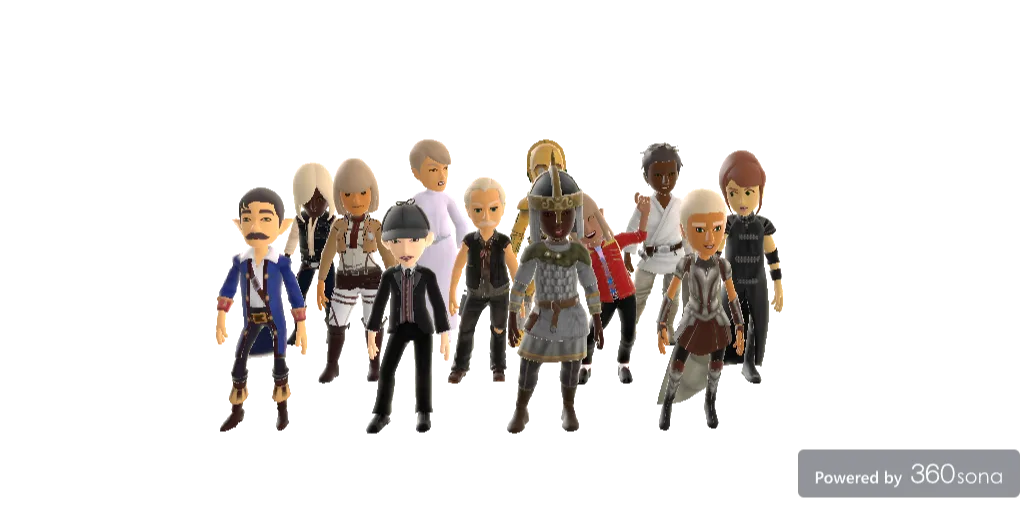
The web SDK takes 256 avatars by default and 1,024 at most (maxAvatars); the native SDK's level of detail below is
for thousands.
The steps
Each sona_update with a view gives every avatar in view a step from its height on screen in pixels
(1.8 m * scale projected at the avatar's depth):
| Step | When | Posed, and drawn as |
|---|---|---|
SONA_LOD_FULL |
height >= full_px |
every frame; its meshes |
SONA_LOD_SAMPLED |
quarter_px <= height < full_px |
when the clip reaches a new frame; its meshes |
SONA_LOD_QUARTER |
height < quarter_px |
as SAMPLED, and at most every 4th frame; its meshes |
SONA_LOD_SPRITE |
height < sprite_px and its look is baked |
never; one sprite |
FULL, SAMPLED and QUARTER apply with sprites on or off; sona_lod_set sets their two thresholds. An avatar becomes a sprite
below sprite_px and turns back into a mesh above sprite_px * 1.15, so one standing on the line does not
flicker. With no view (sona_update(ctx, dt, NULL, NULL)) every avatar is FULL.
The options
typedef struct sona_lod_options {
  float full_px;          /* default 120 */
  float quarter_px;       /* default 40 */
  float sprite_px;        /* default 48; 0: never a sprite */
  float fade_seconds;     /* default 0.25; 0: a cut */
  uint32_t sprite_angles; /* default 8 */
  uint32_t sprite_height; /* default 64 */
  uint32_t max_looks;     /* default 16384 */
  float bake_ms;          /* default 4 */
} sona_lod_options;
| Field | Unit and range | Meaning |
|---|---|---|
full_px |
pixels, >= quarter_px |
At or above it an avatar is posed every frame |
quarter_px |
pixels, 0 .. full_px |
Below it an avatar is posed at most every 4th frame |
sprite_px |
pixels, >= 0 |
Below it an avatar becomes a sprite. 0 turns sprites off |
fade_seconds |
seconds, 0 .. 10 |
How long a mesh-to-sprite crossfade takes, and a turn-to-turn one |
sprite_angles |
pictures, 4 .. 32 |
Turns baked per look, evenly round the avatar |
sprite_height |
pixels, 32 .. 512 |
Height of one baked picture, an even number; its width is half of it |
max_looks |
looks, 1 .. 65536 |
Baked looks kept per renderer. Avatars past it stay meshes |
bake_ms |
milliseconds, >= 0 |
Baking time allowed per sona_draw. At least one batch of looks is baked each draw that needs one |
Note
sprite_angles * sprite_height / 2 must be 4096 or less (one sheet is that many pixels wide).
A new ctx has thresholds 120 and 40 and sprite_px 0: no sprites until sona_lod_set.
void sona_lod_defaults(sona_lod_options *o) 
Writes the defaults in the table above (sprites on at 48 px). NULL is ignored.
sona_result sona_lod_set(sona_ctx *ctx, const sona_lod_options *o)
Sets the options. NULL sets the defaults. Takes effect at the next sona_update.
SONA_E_ARGUMENT:ctxis NULL, or a value is out of range (also NaN). Nothing changes.SONA_E_ARGUMENTalso whensprite_pxis above 0 and a renderer already on the ctx cannot bake these options (see The bake target below). Nothing changes then either.SONA_E_MEMORY: the allocator failed (first call only).- Changing
sprite_anglesorsprite_heightdrops every baked sheet; they are baked again as they are needed.
sona_result sona_lod_get(const sona_ctx *ctx, sona_lod_options *out)
Copies the current options. SONA_E_ARGUMENT for a NULL argument.
uint32_t sona_avatar_lod(const sona_avatar *a, float *fade)
The avatar's step at the last sona_update, and in *fade how far it is from its mesh (0) to its sprite (1).
SONA_LOD_FULL and 0 for NULL, an avatar that is not READY, or one that was not in view at that update (culled
by the view, or hidden). An avatar that comes back into view has its step again: a sprite that was culled is a
sprite again at once, with no new crossfade. fade may be NULL.
void sona_lod_stats_get(const sona_ctx *ctx, sona_lod_stats *out)
typedef struct sona_lod_stats {
  /* avatars in view per step at the last sona_update */
  uint32_t full, sampled, quarter, sprite;
  /* of those, crossing between a mesh and a sprite */
  uint32_t fading;
  /* baked looks, over every renderer */
  uint32_t looks;
  /* looks baked by the last sona_draw or sona_snapshot */
  uint32_t bakes;
  float bake_ms;                             /* time those bakes took */
} sona_lod_stats;
All zero before the first sona_lod_set. NULL arguments are ignored.
Threads: all five functions belong to the ctx's owner thread, like every other ctx call.
sona_lod_defaults touches no ctx and is safe anywhere.
Sprites
A look is the avatar's manifest: avatars with the same 1000 bytes share one sheet, whatever their scale,
place or clip. A sheet holds sprite_angles pictures side by side, each sprite_height / 2 by
sprite_height pixels, of the avatar turned by 360 / sprite_angles degrees each. Each picture sits in a gutter of
sprite_height / 16 pixels on every side, which takes whatever spills out of the baked box (the sprite never shows
it). With the defaults a sheet is 320 x 72 pixels of four bytes, so its GPU memory is a fixed 92,160 bytes.
Atlas pages. Sheets live in atlas pages, sRGB textures of up to 2,048 x 2,048 (less on a device whose textures
are smaller), in columns: 168 sheets to a page with the defaults (a default page of 1,920 x 2,016 pixels). A page is made when the
last one is full and released when its last sheet goes. At the default page size 10,000 different looks take 60 pages (the default is 15.5 MB a page). sona_stats.gpu_mb counts the pages with the GPU caches.
Baking. The first sona_draw (or sona_snapshot) in which an avatar wants a sprite and its look has no
sheet bakes it: the core renders up to 32 looks, all turns, in one pass laid out exactly as their slots in the
page, without the shadow pass (every cell shares one light view, so a shadow map would mix them). sona_draw
records that pass into the host's frame ahead of the picture, presented straight into the page: no readback and
no wait (on GL a framebuffer blit, or a copy through the CPU where the context cannot turn sRGB writes off).
Such a draw uses two frame indices (the pass and the picture), so it counts twice against frames_in_flight. sona_snapshot bakes through the backend's readback and a region
upload, the same pixels byte for byte. A draw bakes one pass; a pass that is not full waits up to 6 draws for
more looks, so a crowd that becomes ready a few avatars a frame bakes in passes of many looks. Sheets nobody used
in the last few draws make room when max_looks is reached, and a pass then takes a run of the slots they gave
back in one column of a page. sona_lod_stats.bakes and bake_ms say which draws
baked and what it cost them on the CPU.
The queue (Vulkan). sona_draw on Vulkan only records into the host's command buffer, bakes included; it never
submits. sona_snapshot submits and waits on the VkQueue from sona_device_desc, as it always has: keep other
threads off that queue while it runs.
The bake target. One pass is one column of sheets: a sheet wide (sprite_angles * (sprite_height / 2 + 2 *
(sprite_height / 16)) pixels) and a sheet tall (sprite_height + 2 * (sprite_height / 16)) per look, up to 32
looks. With the defaults that is 320 x 2,304 pixels at most. It must fit the device's largest texture:
sona_lod_setrefuses options whose one-look bake is wider or taller than the largest texture of a renderer already on the ctx (SONA_E_ARGUMENT). The widest bake the ranges allow is 5,120 pixels (32 angles at 256 px).- A device that fits a sheet but not 32 bakes fewer looks per pass.
- A renderer made after
sona_lod_seton a device too small for the options draws no sprites. It logs a warning once, and its avatars stay meshes (see the next point).
More than one renderer. Sheets belong to a renderer, but the crossfade belongs to the avatar. So an avatar turns
into a sprite only when every renderer that drew it since the last sona_update has its look baked. While a
renderer that cannot draw sprites draws the same ctx (a Metal or Xenos one next to a Vulkan one, or a device too small for
the bake), far avatars stay meshes, posed at the QUARTER rate, on every renderer. When it stops drawing, sprites
come back over fade_seconds. Each draw still shows a mesh wherever its own renderer has no sheet, so no renderer
loses an avatar.
The picture is the avatar as the baking avatar was posed at that moment, seen from the depth where sprites start for that draw's view (the shading reads view-space depth: past about 18 m the shadow lookup leaves avatars half lit, and a sheet baked there matches them).
Drawing. All sprites of one page go in instanced draws of up to 110 (one cb block each), after the opaque
meshes; each sprite names its slot in the page. Each sprite faces the camera, scaled with the avatar, centred
0.9 m up. It shows the turn nearest to the angle the camera sees the avatar from; when that changes by more than 0.65 of a step, the new picture crossfades in over
fade_seconds with an ordered dither.
The crossfade. Between mesh and sprite both are drawn for fade_seconds: the sprite, pulled toward the camera
along the view ray (so it covers the same pixels), takes over a growing share of a 4x4 dither pattern. In the
pixels it has taken, its transparent texels still write depth, so the mesh, drawn after it, gives those pixels up
too: the silhouette crosses over with the inside, and no frame of the crossfade is a visible cut.
What a sprite does not show
- Motion. A sprite holds the baking avatar's pose. Its clip clock still runs (clip time, queue, crossfades,
root motion
APPLYall go on), so it is posed correctly the moment it turns back into a mesh. - Per-avatar changes on the same manifest. Expressions set with
sona_avatar_expressionand pose overrides do not reach the sprite. - A held prop's own clip. Props drawn only while performing are not in the picture.
- Clip events from the pose. Footfalls come from the evaluated pose, so a sprite has none (as a culled avatar has none). Started, looped, ended and mark events still arrive.
- Joints.
sona_joint_world,sona_avatar_capsuleandsona_posegive the last pose computed before the avatar became a sprite. - Very wide items: the baked box is 1.1 m wide and 2.2 m tall (from 0.2 m below the feet). Anything outside it is cut off in the sprite: up to 0.27 m past a side, the top or the bottom it lands in the gutters between pictures; further out it can show at the edge of the neighbouring picture.
Backends
| Backend | Sprites |
|---|---|
| Vulkan | Yes |
| GL 3.3, GLES 3.0 | Yes |
| D3D11, D3D12 | Yes, baked in the avatar's style. On D3D12 sona_draw records the bake on the backend's own list and submits it ahead of the host's |
| Metal, Xenos | No: their caps report no sprites, so far avatars stay meshes at the QUARTER rate |
Example: a stadium
/* 10,000 avatars in rows round a pitch, facing in */
sona_lod_set(ctx, NULL);
for (i = 0; i < 10000; i++) {
  sona_add_options o;
  sona_add_defaults(&o);
  seat(i, o.place.position, &o.place.turn_deg);   /* your layout */
  /* random start: a crowd out of step */
  o.start_at = -1;
  sona_avatar_add_base64(ctx, looks[i % 12], &o, &av[i]);
}
// 10,000 avatars in rows round a pitch, facing in
// sona.hpp has no wrapper: the C call on the handle
sona_lod_set(ctx.raw(), nullptr);
std::vector<sona::Avatar> crowd;
for (uint32_t k = 0; k < 10000; k++) {
  sona_add_options o = sona::add_defaults();
  // your layout
  o.place.position[0] = (float)(k % 100) - 50;
  o.place.position[2] = (float)(k / 100);
  // random start: a crowd out of step
  o.start_at = -1;
  crowd.push_back(ctx.add_base64(std::string(b64), o));
}
// 10,000 avatars in rows round a pitch, facing in
ctx.SetLod();
var crowd = new List<SonaAvatar>();
for (var k = 0; k < 10000; k++)
    crowd.Add(ctx.Add(manifest, new SonaAddOptions {
        // your layout
        Placement = new SonaPlacement(k % 100 - 50, 0, k / 100),
        // random start: a crowd out of step
        StartAt = -1,
    }));
// 10,000 avatars in rows round a pitch, facing in
ctx.set_lod(None)?;
let mut crowd = Vec::new();
for k in 0..10000u32 {
    let mut o = AddOptions::default();
    // your layout
    o.place.position = [(k % 100) as f32 - 50.0, 0.0, (k / 100) as f32];
    // random start: a crowd out of step
    o.start_at = -1.0;
    crowd.push(ctx.add(manifest, &o)?);
}
# 10,000 avatars in rows round a pitch, facing in
ctx.set_lod()
# your layout
crowd = [ctx.add(manifest, position=(k % 100 - 50, 0, k // 100),
                 # random start: a crowd out of step
                 start_at=-1)
         for k in range(10000)]
sona-bench --scene crowd --layout stadium --lod on runs this layout (rows 0.62 m apart round a 72 x 48 m
pitch, the camera behind one end) and --shot <prefix> writes a full-size PNG per step.
Measured
Every figure here is filled in from a sona-bench run's own output. The scene: every avatar in its own random
outfit and body from the full catalogue, 1920 x 1080, the median of three runs.
| 1,000 different avatars, grid | ms a frame (CPU, GPU) | Draws a frame; all ready after |
|---|---|---|
| RTX 4000 Ada machine, Vulkan | 1.79 (1.77, 1.59) | 9,470; 3,318 ms |
| Intel Arc iGPU (Core Ultra 9 185H), Vulkan | 14.05 (3.38, 13.98) | 9,470; 2,422 ms |
| RTX 4090 machine, Vulkan | 16.15 (3.48, 16.13) | 9,470; 2,380 ms |
| The same machine, GL | 33.53 (33.5, 33.52) | 9,470; 2,695 ms |
The RTX 4000 Ada and RTX 4090 rows are different machines, and the host as well as the card sets the figure. The GL row is the same frame through the GL backend on the RTX 4090 machine.
The stadium, 10,000 different avatars with LOD (--layout stadium --lod on --max-looks 10000), the median of three runs:
| 10,000 different avatars, stadium | ms a frame (CPU, GPU) | Draws; ready after; memory |
|---|---|---|
| RTX 4000 Ada machine | 7.56 (7.5, 2.87) | 5,831 draws; 21,063 ms; CPU 6,973.9 MB, GPU 1,524.6 MB |
| Intel Arc iGPU (Core Ultra 9 185H) | 11.46 (7.84, 11.37) | 5,831 draws; 14,939 ms; CPU 6,876.7 MB, GPU 1,524.6 MB |
LOD is what makes the stadium possible: the far avatars are drawn as sprites from atlas pages, so the stadium's 10,000 take fewer draws than the grid's 1,000 (the Draws column). Every avatar still holds its own build, which is the CPU MB column.
A new avatar from bytes already in memory and from a cold read, CPU only, twelve avatars, on the Core Ultra 9 185H:
| Cache | Median ready (ms) | Slowest ready (ms) |
|---|---|---|
| Warm | 25.77 | 28.42 |
| Cold | 26.11 | 31.78 |
To measure on your own machine, run sona-bench from your download: performance.
Limits
- A sprite draw holds at most 110 sprites (one 3,584-byte cb block).
max_looksis a set count (default 16,384), not read from the device's memory. On a small device an app with thousands of looks can ask for hundreds of MB of pages; a page that cannot be made leaves those avatars as meshes. Setmax_lookslower on such devices.- Avatars between
sprite_pxandfull_pxdraw as meshes, simplified to about half their triangles below 120 pixels (hardening); they are where most of the GPU time goes. - Metal and Xenos have no sprites: their far avatars stay meshes, posed at the QUARTER rate.
- A sprite is a still picture: a far avatar does not animate.
- Every avatar holds its own build (the CPU MB column above), even when many share a look.
- The per-avatar work in
sona_update(clock, culling, LOD) runs on the owner thread for every avatar.
This page as Markdown · All the docs as one file (llms-full.txt)