2D outputs: sprite sheets, stickers and pixel art
Pictures of an avatar for 2D games, chat and pixel-art games, made by the SDK with no art tool in between:
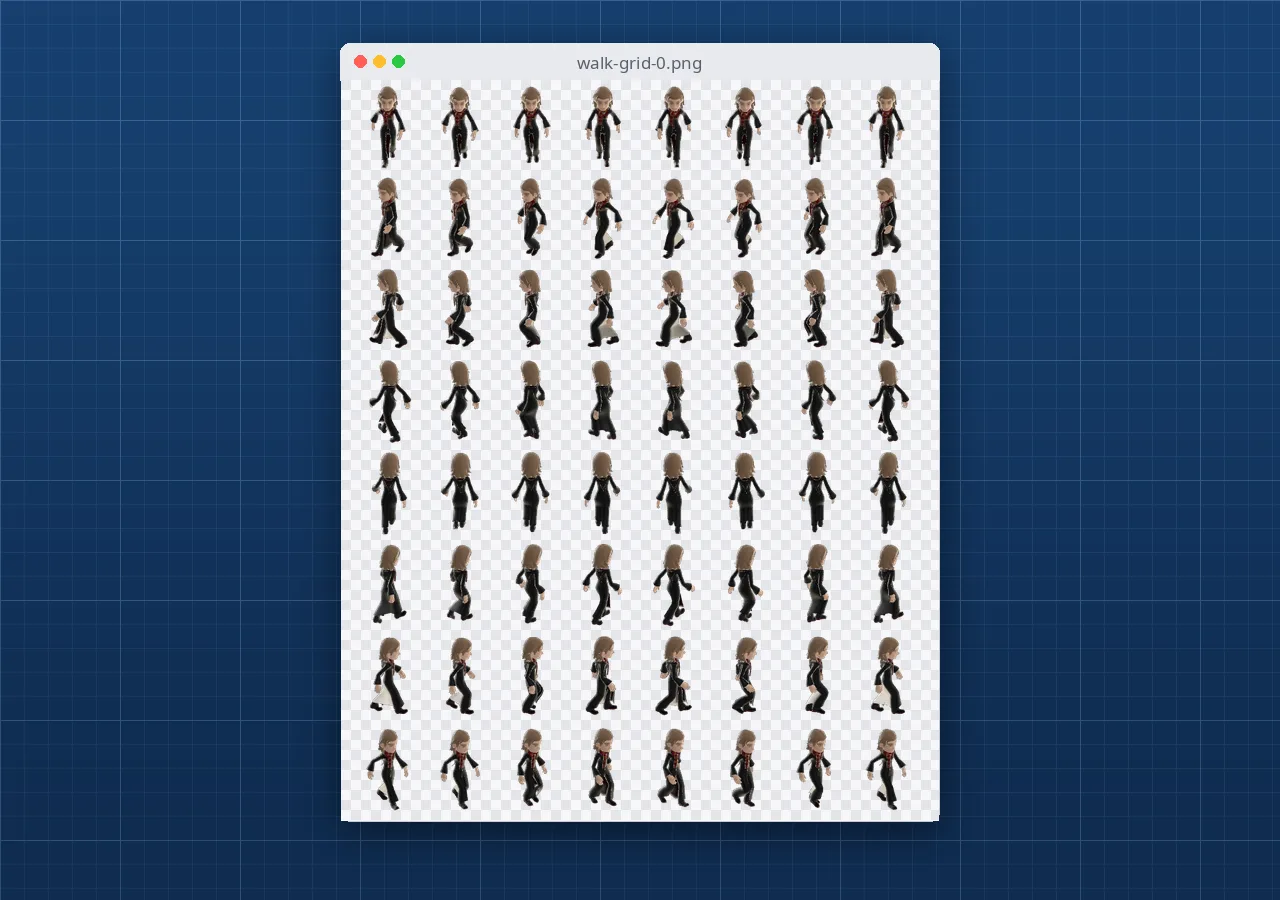
- Sprite sheets: a clip rendered at N frames in M directions, trimmed, padded and packed on pages, with an atlas in Aseprite's or TexturePacker's JSON form. Or a plain grid, a row per direction.
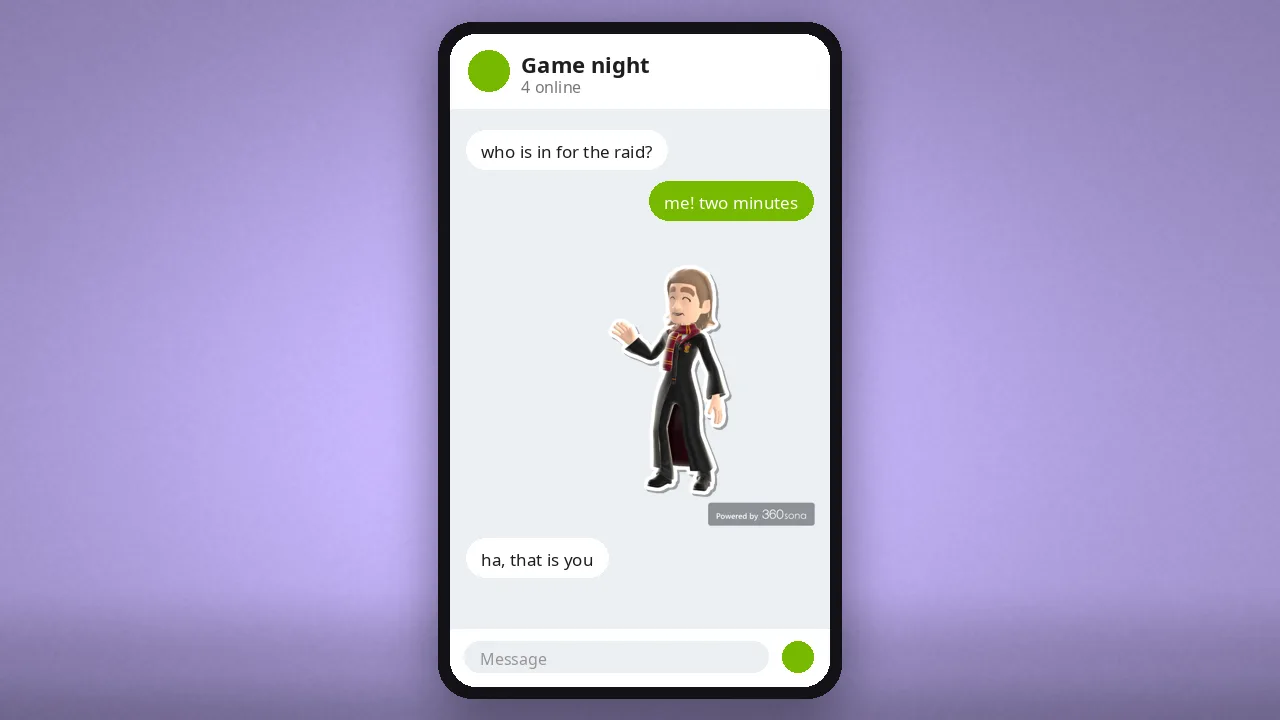
- Stickers: a transparent, outlined cut-out of the avatar in a pose or an emote's frame.
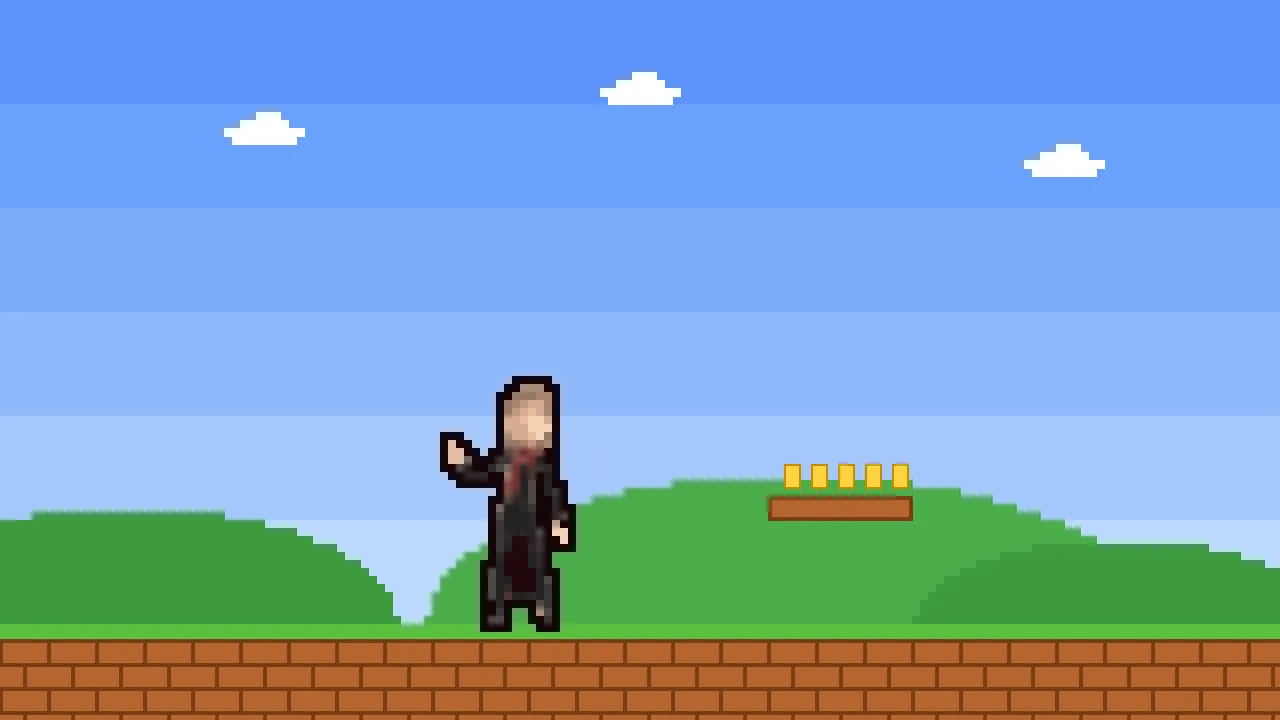
- Pixel art: any picture brought down to a small height with a small palette, every pixel opaque or clear. Sheets can be pixel art too, with one palette for every frame.
Everything draws through sona_snapshot, the headless path the core already has, so any backend with a readback can
make them. They are tested on Vulkan, GL 3.3 and GLES 3.0.
Quick start
sona_sheet_options o;
sona_sheet *sheet = NULL;
sona_result r;
sona_sheet_defaults(&o);
/* a clip key ("GenericWave") or a clip id */
o.clip = "00400000-0064-0003-c1c8-f109a19cb2e0";
o.name = "walk";
/* a top-down RPG camera */
o.pitch_deg = 30;
while ((r = sona_sheet_render(renderer, avatar, &o,
    &sheet)) == SONA_PENDING)
  /* the clip's file is loading */
  sona_update(ctx, 0, NULL, NULL);
if (r == SONA_OK) {
  sona_picture page;
  char *json;
  size_t len;
  /* RGBA8: sona_png_encode it as walk-0.png */
  sona_sheet_page(sheet, 0, &page);
  sona_sheet_atlas(sheet, SONA_ATLAS_ASEPRITE, 0, "walk-{n}.png", &json,
                   &len);
  /* ... write json ... */
  sona_free(ctx, json);
  sona_sheet_free(sheet);
}
sona_sheet_options o;
sona_sheet *sheet = nullptr;
sona_result res;
sona_sheet_defaults(&o);
// a clip key ("GenericWave") or a clip id
o.clip = "00400000-0064-0003-c1c8-f109a19cb2e0";
o.name = "walk";
o.pitch_deg = 30;                                 // a top-down RPG camera
while ((res = sona_sheet_render(r.raw(), avatar.raw(), &o,
    &sheet)) == SONA_PENDING)
  // the clip's file is loading
  ctx.update(0);
if (res == SONA_OK) {
  sona_picture page;
  char *json = nullptr;
  size_t len = 0;
  // RGBA8: png_encode it as walk-0.png
  sona_sheet_page(sheet, 0, &page);
  sona_sheet_atlas(sheet, SONA_ATLAS_ASEPRITE, 0, "walk-{n}.png", &json,
                   &len);
  // ... write json ...
  sona_free(ctx.raw(), json);
  sona_sheet_free(sheet);
}
var o = SonaRenderer.SheetDefaults();
o.pitch_deg = 30;                                // a top-down RPG camera
// a clip key ("GenericWave") or a clip id
using var sheet = r.RenderSheet(avatar, o,
    "00400000-0064-0003-c1c8-f109a19cb2e0", "walk");
var page = sheet.Page(0);                        // the first page's pixels
let mut o = sheet_defaults();
o.pitch_deg = 30.0;                              // a top-down RPG camera
// a clip key ("GenericWave") or a clip id
let clip = "00400000-0064-0003-c1c8-f109a19cb2e0";
let sheet = loop {
    if let Some(s) = r.sheet(avatar, &o, Some(clip), Some("walk"), None)? {
        // None while the avatar's files are still arriving
        break s;
    }
};
let (rgba, width, height) = sheet.page(0)?;
# The Python package has no renderer on a device of your own: it reads
# avatars as data (avatar.pose()) for an engine
# to draw, and draws pictures with sona.Headless.
o = sona.sheet_defaults()
samples/c/sprites2d_vk.c does all three outputs headless on Vulkan and writes the files.
How a picture is made
- The avatar is staged alone. For the length of the call the avatar is the only visible one, stands at the
origin, and is posed at each time asked for. Its state is copied first and put back after: placement, clip and
clip time, pose, fades, clip events, root motion, visibility and its crowd step. The host's clip keeps playing
from where it was, and the next
sona_updateandsona_drawgive the same picture they would have given without the call (sprites2d_vkchecks it byte for byte). Joint overrides stay applied. The clip's own face track is baked into the pictures (an emote's laugh, a yawn), part by part where the host has not set an expression withsona_avatar_expression; the face sheet is put back byte for byte after. - The clip is read on its own. A clip named in the options (a key such as
"GenericWave", a raw clip id, or"prop"for the held prop's clip) is fetched from the ctx's sources without touching the avatar's own clip. Until its file has arrived the call returnsSONA_PENDING: runsona_updateand call again. A NULL clip samples the clip the avatar plays now (sheets), or keeps the pose it has now (stickers). - The camera is fixed for the whole sheet. Direction 0 faces
first_deg(0: towards the camera, south; 90: screen left, west; 180: away; 270: screen right), and the others follow clockwise seen from above, evenly round. The avatar turns; the camera and the light do not, so every direction is lit from the same side of the screen, as hand-drawn sprites are. The camera looks down bypitch_deg: 0 side on, 30 for top-down RPGs, 26.565 for 2:1 isometric.fov_deg0 is orthographic (a 0.5 degree camera from far away: depth changes the scale by a negligible amount). So every frame has the same scale and a feet point that does not move. - The frame box comes from the joints, every frame at every turn, with room for hands, hair, hats and soles
(0.25 m at the sides, 0.32 m on top, 0.14 m below). A picture that still touches the edge of its cell (a big
hat, a held prop, a wide dress) grows that edge by 0.3 m and the sheet is drawn again, up to five times.
px_per_metresets the scale: at 64 a 1.8 m avatar is about 115 pixels tall, whatever the clip. - Walk cycles stay in place. The hips are held where the clip starts (root motion EXTRACT for the call), so a
walk walks on the spot and the game moves the sprite.
SONA_SHEET_ROOT_MOTIONkeeps the travel in the pictures instead.
Frames are sampled at from + span * i / frames (span = to - from, or the whole clip), which suits a loop: the
last frame is not the first again. SONA_SHEET_ENDS samples both ends (span * i / (frames - 1)) for clips that
play once. Each frame lasts span / frames (or span / (frames - 1)) in the atlas, in milliseconds.
Sprite sheets
- Trimmed. Each frame keeps the box of its pixels (alpha above 0) plus
paddingclear pixels round it, inside its cell. The atlas records where that box sat in the cell (spriteSourceSize) and the cell's size (sourceSize), so engines draw it at the right place.SONA_SHEET_NO_TRIMkeeps whole cells. - Made unique. Frames with the same pixels at the same place share one rectangle (a held still pose, the two
ends of a loop);
sona_sheet_frame.aliasnames the first.SONA_SHEET_NO_DEDUPturns it off. - Packed. A skyline packer (bottom left, tallest first) fills pages no bigger than
max_pageon a side, trying several page widths and keeping the one with the smallest largest side, then the least area: square-ish pages, not strips. More pages when one is not enough.SONA_SHEET_POW2makes both sides powers of two. Nothing is rotated. - Grid.
SONA_SHEET_GRIDlays whole cells in a grid, a row per direction and a column per frame (rows wrap atmax_page; whole directions per page). That is what Godot'sSprite2D(hframes,vframes) and Unity's Sprite Editor (Grid By Cell Size) slice without any importer. - The pivot is the avatar's feet, its placement's origin, in the cell:
sona_sheet_frame.pivot_xandpivot_y. TexturePacker JSON carries it per frame (pivot, as a fraction of the cell); Aseprite JSON as a slice namedpivotwith the cell as its bounds. - Names. Frames are
<name>_<direction>_<nnn>(walk_west_003); directions are compass names at multiples of 45 degrees (south,southwest,west, ...southeast), elsedir<k>. Each direction is an Aseprite frame tag and a TexturePacker animation named<name>_<direction>. - Pixel-art sheets. With
pixelset, cells are drawn at up to eight times the size, brought down with the area filter, then cut to opaque or clear and mapped to one palette made from every frame (orpixel->palette), with the outline if asked.px_per_metreis then the pixel art's own scale (18 gives a figure about 32 pixels tall);pixel->heightis not used.
The atlas formats
sona_sheet_atlas(sheet, format, page, image, &json, &len) writes one page's atlas as NUL-terminated UTF-8 JSON,
freed with sona_free. image is the page's file name for meta.image; {n} in it becomes the page number.
SONA_ATLAS_ASEPRITE: Aseprite's "array" export:frames(filename, frame, rotated, trimmed, spriteSourceSize, sourceSize, duration),metawithframeTags(one per direction,forward), onelayersentry and thepivotslice: the form Phaser 3'sload.asepriteand the engine plugins that import Aseprite exports are made for.SONA_ATLAS_TEXTUREPACKER: TexturePacker's "JSON (Hash)":frameskeyed by name, each with apivot,animations(name to frame names, the form PixiJS reads), andmeta. Phaser 3'sload.atlasand PixiJS'sSpritesheetread it.pageSONA_ATLAS_ALL_PAGESwrites every page in one file, in the multi-atlas form (textures, Phaser 3'sload.multiatlas).
Both put "app": "https://360sona.com" and "credit": "Powered by 360sona" in meta. Numbers are written without
exponents and without the locale, so a host in any language gets valid JSON.
What has been checked: the core's JSON reader parses every atlas, and the trimmed frames put back at their offsets
rebuild every grid cell byte for byte (sprites2d_vk, sprites2d_gl). Godot 4.7 reads the sample's atlases with
its own JSON and Image classes, rebuilds the cells exactly, turns the Aseprite tags into SpriteFrames
animations of AtlasTextures whose margins keep the full cell (sprites2d_godot). Phaser, PixiJS, Unity and
Aseprite themselves have not been run against these files.
Stickers
sona_sticker(renderer, avatar, &options, &picture) draws the avatar alone, turned turn_deg from facing the
camera, at time seconds into clip (negative: its middle), framed by framing:
SONA_PRESET_FULL: the whole figure, from the joints' box, grown until nothing touches the frame.SONA_PRESET_UPPER,_BUST,_FACE: the console's own framings (sona_camera_preset), cut at the frame's edge, for reaction and emote stickers ("Laugh", "ShockedSurprised").
It is drawn at twice the size, cut to its pixels, brought down with the area filter so the longer side is pixels
less the outline, and then given an outline outline_px wide (a true distance from the figure's edge, smooth at
any width; default white, 10 pixels), an optional hard drop shadow shadow_px down and right, padding clear
pixels round it, and with SONA_STICKER_SQUARE a square canvas. The canvas is pixels + 2 * padding + shadow
on its longer side. The picture is the caller's: sona_free(ctx, picture.rgba).
The credit badge is stamped bottom right at three quarters of its size, unless draw_flags has SONA_DRAW_NO_CREDIT (the app then shows
the credit itself, as the licence requires). A sticker too small for the badge gets none and a warning in the log.
Pixel art
sona_pixel_art(ctx, &in, &options, &out) works on any picture: a sticker cut-out (use outline_px 0 and
SONA_DRAW_NO_CREDIT), a snapshot, an item preview.
- The figure's box (pixels with alpha 8 and up;
SONA_PIXEL_KEEP_FRAME: the whole picture) is scaled toheightpixels, less two for the outline, with an area filter: each output pixel is the coverage-weighted mean of the input it covers. No blur beyond that. - Each pixel becomes opaque or clear at
alpha_cut(0.5): no half-transparent pixels. - Colours are mapped to the palette:
palette(0xRRGGBB) when given, elsecolourscolours made from the picture by median cut on a 15-bit histogram and six rounds of k-means, all in integers, darkest first. Distances weigh red, green and blue 3 : 4 : 2.SONA_PIXEL_DITHERadds an ordered 4 x 4 pattern first. SONA_PIXEL_OUTLINE(on by default) paints the clear pixels next to the figure inoutline, or, when its alpha is 0, the palette's darkest colour a third darker.SONA_PIXEL_OUTLINE_THINuses the four side neighbours only.
The result is exactly height pixels tall. sona_pixel_palette(ctx, pictures, n, colours, palette, &count) makes
one palette for several pictures, to pass as palette so a character's frames and poses share colours (a
pixel-art sheet does this by itself).
Palettes and mapping are integer maths; the area filter and the outline distance are IEEE doubles and floats with contraction off, so the same picture comes out on x86-64, arm64 and big-endian PowerPC.
Types
sona_sheet_options
| Field | Meaning | Default |
|---|---|---|
size |
sizeof(sona_sheet_options); calls refuse a struct without it |
set |
frames |
frames per direction, 1..1024 | 8 |
clip |
a clip key, a raw clip id or "prop"; NULL: the clip the avatar plays now |
NULL |
name |
the animation's name in the atlas (up to 63 bytes); NULL: the clip as named, "pose" without one |
NULL |
from, to |
seconds into the clip; to <= from: all of it |
0, 0 |
directions |
1..64 | 8 |
first_deg |
direction 0's facing | 0 |
pitch_deg |
camera elevation, -45..89 | 0 |
fov_deg |
0: orthographic; else 1..90 | 0 |
px_per_metre |
2..1024 | 64 |
padding |
clear pixels round each trimmed frame, 0..64 | 2 |
max_page |
the largest page side, 64..16384 | 4096 |
flags |
SONA_SHEET_POW2, _NO_TRIM, _ROOT_MOTION, _NO_DEDUP, _ENDS, _GRID |
0 |
draw_flags |
SONA_DRAW_* for the pictures; NO_CREDIT is always added |
SONA_DRAW_NO_BLOOM |
reserved |
0 | 0 |
pixel |
not NULL: pixel-art frames | NULL |
80 bytes with 8-byte pointers, 68 with 4-byte ones.
sona_sheet_frame
page, x, y, w, h (the rectangle on the page), trim_x, trim_y (where it sits in the cell), cell_w,
cell_h (the same for every frame), pivot_x, pivot_y (pixels in the cell), direction, frame,
facing_deg, time (seconds into the clip), duration_ms, alias. 68 bytes. Frames are direction-major:
index = direction * frames + frame.
sona_sticker_options
| Field | Meaning | Default |
|---|---|---|
size |
sizeof(sona_sticker_options) |
set |
pixels |
the cut-out's longer side, outline included, 32..4096 | 512 |
clip, time |
the pose: a clip and seconds into it (negative: its middle); NULL clip: the pose it has now | NULL, -1 |
turn_deg |
the avatar's turn from facing the camera | 0 |
framing |
SONA_PRESET_FULL, _UPPER, _BUST, _FACE |
FULL |
outline_px, outline |
outline width (0..128; 0: none) and 0xAARRGGBB | 10, 0xffffffff |
shadow_px, shadow |
drop shadow offset (0..128; 0: none) and 0xAARRGGBB | 0, 0x59000000 |
padding |
clear pixels round it, 0..1024 | 8 |
flags |
SONA_STICKER_SQUARE |
0 |
draw_flags |
SONA_DRAW_*; NO_CREDIT: no badge |
0 |
56 bytes with 8-byte pointers, 52 with 4-byte ones.
sona_pixel_options
| Field | Meaning | Default |
|---|---|---|
size |
sizeof(sona_pixel_options) |
set |
height |
the output's height, outline included, 4..1024 | 32 |
colours |
palette size made from the picture, 2..256 | 16 |
flags |
SONA_PIXEL_OUTLINE, _OUTLINE_THIN, _DITHER, _KEEP_FRAME |
OUTLINE |
outline |
0xAARRGGBB; alpha 0: from the palette | 0 |
alpha_cut |
0.01..1 | 0.5 |
palette, palette_count |
0xRRGGBB colours to map onto (1..256), or NULL | NULL, 0 |
reserved |
0 | 0 |
40 bytes with 8-byte pointers, 36 with 4-byte ones.
sona_picture
rgba (straight RGBA8, row 0 at the top), width, height. Pictures from sona_sticker and sona_pixel_art
are the caller's (sona_free(ctx, p.rgba)); pages from sona_sheet_page belong to the sheet.
Rules
- One owner thread, as every call on a ctx. A sheet or a sticker is many
sona_snapshotframes: each blocks until the GPU is done, and on Vulkan submits on the device's queue (keep other threads off it during the call). When no frame of the host's was in flight when the call began, the call reports its own frames done before it returns; otherwise report them withsona_renderer_frame_doneas for any snapshot. SONA_E_NOT_READYbefore the avatar is READY;SONA_E_ARGUMENTfor an item preview (draw those withsona_item_preview_snapshot), a renderer of another ctx, options without theirsize, a value out of range or an unknown clip key;SONA_E_NOT_FOUNDfor a clip whose file cannot be read, a sticker of nothing, or pixel art with no pixel opaque enough;SONA_E_LIMITwhen a frame cannot fitmax_page, a cell would need a render over 8192 pixels, or the cells would pass the 1 GB limit. A sheet frame that drew nothing gets a 1 x 1 clear rectangle.- Free every sheet with
sona_sheet_freebeforesona_close. - The bench path is untouched: nothing here runs inside
sona_updateorsona_draw.
Numbers
The sample, one avatar, WalkForward, 8 directions of 8 frames, pitch_deg 30. It ran on an RTX 4090 machine,
Vulkan; the median of three runs:
sprites2d_vk |
ms to draw |
|---|---|
| The packed sheet, 80 px per metre | 32 |
| The grid, a row per direction | 10 |
| The pixel-art sheet, 24 px per metre | 31 |
Not counted: the clip's first load.
Tests and sample
| Name | What |
|---|---|
sprites2d |
no GPU: options and their checks, the area filter against block means, the outline's distances, palettes (exact colours, darkest first), posterising, pixel art from a made-up figure, the packer (no overlaps, pages within bounds, powers of two, several pages, a too-big frame refused) |
sprites2d_vk, sprites2d_gl |
on every Vulkan and GL test device: a sheet of a cast avatar's wave (32 frames, every one drawn, pivots inside the cell, both atlases parsed), the avatar afterwards (the same snapshot byte for byte, no new clip events, the same joint, still playing), the same bytes twice, the grid's layout, the packed frames rebuilding the grid's cells; stickers (size, outline, clear corners, a square face sticker); pixel art from a cut-out; a pixel-art sheet (opaque or clear, one palette, powers of two). PNGs as sprites2d-<device>-*.png |
sprites2d_sample_vk |
samples/c/sprites2d_vk.c over the full corpus: the 8-direction walk (packed and grid), the pixel-art walk, a sticker and a 32 px avatar; fails when a frame is empty |
sprites2d_godot |
Godot 4 reads the sample's atlases (samples/sprites2d/godot_atlas_check.gd) |
The first three also pass under ASan and UBSan, built and preloaded as the CI's asan step does.
This page as Markdown · All the docs as one file (llms-full.txt)