VRM and glTF export
sona_export_avatar writes an avatar as one file: VRM 1.0 (the default), VRM 0.x (for apps still on
UniVRM 0.x, such as VSeeFace) or a plain binary glTF. A VRM opens in VTubing apps, social VR and anything with a
VRM loader. It carries a humanoid skeleton, the expressions (visemes, moods, blinks, gaze), look-at and
first-person settings, and the licence fields the user chose. The bone names follow one of the skeleton maps
(Skeleton maps).
sona_export_options o;
sona_export_report rep = { sizeof rep };
uint8_t *file;
size_t len;
/* VRM 1.0, Unity bone names, MToon, most restrictive licence */
sona_export_defaults(&o);
o.name = "My avatar";
o.authors = "Ann";                     /* one per line */
o.licence_url = "https://vrm.dev/licenses/1.0/";
o.avatar_permission = SONA_VRM_EVERYONE;
if (sona_export_avatar(avatar, &o, &file, &len, &rep) == SONA_OK) {
  fwrite(file, 1, len, f);
  sona_free(ctx, file);
}
sona_export_options o;
// VRM 1.0, Unity bone names, MToon, most restrictive licence
sona_export_defaults(&o);
o.name = "My avatar";
o.authors = "Ann";                     // one per line
o.licence_url = "https://vrm.dev/licenses/1.0/";
o.avatar_permission = SONA_VRM_EVERYONE;
sona_export_report rep = { (uint32_t)sizeof rep };
uint8_t *file = nullptr;
size_t len = 0;
if (sona_export_avatar(avatar.raw(), &o, &file, &len, &rep) == SONA_OK) {
  std::ofstream("avatar.vrm",
      std::ios::binary).write(reinterpret_cast<const char *>(file), (std::streamsize)len);
  sona_free(ctx.raw(), file);
}
// VRM 1.0, Unity bone names, MToon, most restrictive licence
var o = new SonaExportOptions
{
    Name = "My avatar",
    Authors = "Ann",                             // one per line
    LicenceUrl = "https://vrm.dev/licenses/1.0/",
    AvatarPermission = SonaVrmPermission.Everyone,
};
if (avatar.TryExport(o, out var file, out var rep))
    File.WriteAllBytes("avatar.vrm", file);
// VRM 1.0, Unity bone names, MToon, most restrictive licence
let o = ExportOptions {
    name: Some("My avatar".into()),
    authors: Some("Ann".into()),                 // one per line
    licence_url: Some("https://vrm.dev/licenses/1.0/".into()),
    avatar_permission: sona_sys::SONA_VRM_EVERYONE,
    ..Default::default()
};
let (file, rep) = avatar.export(&o)?;
std::fs::write("avatar.vrm", file).ok();
# VRM 1.0, Unity bone names, MToon
data, rep = avatar.export(name="My avatar", authors="Ann",
                          licence_url="https://vrm.dev/licenses/1.0/")
with open("avatar.vrm", "wb") as f:
    f.write(data)
The sample samples/c/vrm_export.c does this for any manifest: vrm_export --b64 <manifest>
[--format vrm|vrm0|glb] [--bones unity|vrm|ue4|ue5] [--pbr] [--no-expressions] [--name..]
[--author..] --out avatar.vrm.
What the file holds
- The figure as the editor draws it, in the rig's T-pose with its body shape. Every part the build made (the
body, the head, each worn item) is one mesh, skinned to one skin of 71 joints. The bones have no rotation or
scale (the VRM convention; UniVRM writes the same), stand where the rig's joints stand in the T-pose, and the
vertices are the editor's own vertices skinned into that pose. A clip's own held prop is left out: a VRM is a
humanoid, and a prop's own skeleton and clip have no place in one. Props attached with
sona_avatar_prop_attachare in, each a rigid node under its bone (Props;SONA_EXPORT_NO_PROPSleaves them out). - Handedness. The editor works in a left-handed space with avatars facing -Z. glTF is right-handed, so z is negated and each triangle turned round, and the figure faces +Z with its left hand at +X, as VRM 1.0 wants (the editor's own export does the same). VRM 0.x files face -Z, so there x is negated instead.
- Triangles with no area in the T-pose are left out (the build collapses body triangles under clothes);
report.degeneratecounts them. - One picture per part. The shaders combine up to three textures, each through its own uv set:
c = colour(uv0) * intensity(uv1).a + intensity(uv1).rgb, thenc = c * decal(uv2).a + decal(uv2).rgbfor the families whose third texture is a decal (on a reflective part it is a matcap). glTF has one base colour texture, so the chain is flattened, in linear light, exactly as the editor's own export does it: the colour map as it is when the other two change nothing; else the chain rasterised into the uv set whose picture reads back closest to it; else a fresh chart atlas; and when two surfaces share texels and disagree, a unique layout where every triangle owns its texels.report.bakedcounts the parts flattened andreport.bake_erroris the worst one's readback error. The vertex colour (baked occlusion) is glTF'sCOLOR_0. - Materials. VRM files use MToon (
VRMC_materials_mtoonfor 1.0,VRM/MToonmaterial properties for 0.x), a soft toon shade close to the editor's flat irradiance light;SONA_EXPORT_PBRwrites glTF metal-rough instead. Plain glTF is metal-rough. Cut-out parts areMASKat 0.5 (the shader discards below half), the transparent familiesBLEND, every material single-sided like the editor. - The humanoid: the 51 joints of the VRM map, every required bone among them.
- First person: meshes skinned only to the head are
thirdPersonOnly; the rest areauto, which lets the VRM runtime cut the head's triangles out of them. - Look-at:
expressiontype, from a point between the eyes measured on the face's own triangles; up to 20 degrees maps onto the gaze expressions. - Meta: name, version, authors, copyright, contact, references, third-party licences, the licence URL, the
avatar permission, commercial use, modification, redistribution, the violence, sexual, political and
antisocial flags, the credit notation, and an optional thumbnail PNG (
sona_snapshotplussona_png_encodemake one). VRM 0.x takes the nearest of its fields. The defaults are the most restrictive: only the author, personal non-profit use, no modification or redistribution, credit required.asset.copyrightcarries the user's copyright, else the credit "Powered by 360sona, https://360sona.com".
Expressions
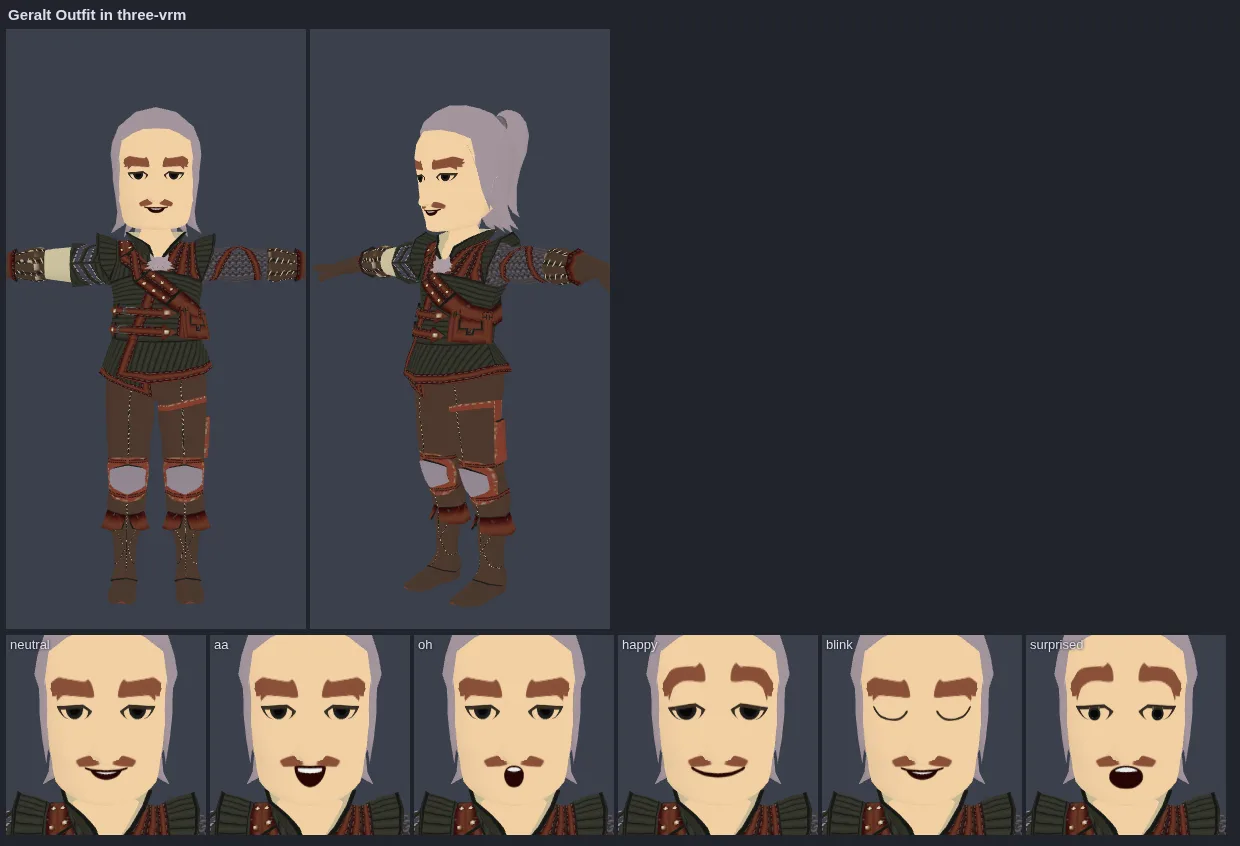
A face here is a picture, not a shape: the head's face sheet is baked from the mouth, eyebrow and eye shapes of
the face items (14 mouths, 5 brows, 14 eyes; sona_avatar_expression). So an expression cannot be a morph target.
It is a texture offset, VRM's textureTransformBinds (VRM 0.x: _MainTex_ST material values), which every VRM
runtime applies.
- The face sheet's triangles are sorted by the face parts their texels belong to, found by baking every shape each expression asks for and comparing with the neutral face. The mouth, each brow and each eye come out as separate groups of triangles (on the cast no triangle touches both the mouth and an eye).
- Each group gets its own material and an atlas: a crop of the face sheet around its triangles, once per face
that group can show, baked with the same code
sona_avatar_expressionuses. Each cell is baked from the group's own triangles only, so an export bakes about 130 small sheets instead of 130 full ones. - An expression moves its groups' texture offset to its cell. Overlapping expressions add their offsets, so the cells sit on axes, each a digit of a mixed-radix number along x or y: visemes (aa ih ou ee oh, one at a time), moods (happy angry sad relaxed surprised, one at a time), gaze (left or right plus up or down: diagonals have their own cells) and lids (blink plus the side's own blink). Any mix of one viseme, one mood, a gaze and the blinks lands on a cell baked for exactly that mix. What a cell shows is decided in this order: the mood, then the gaze, then the viseme, then the lids, so a blink closes a sad eye and a viseme speaks through a smile. Two moods at once, or two visemes at once, land on another expression's cell: drive one of each.
- Every expression is
isBinary(a weight over 0.5 is on): half an offset is a smeared face. - The default faces (
sona_vrm_face_default): aa AI, ih EE, ou W, ee L, oh O; happy is the happy mouth and eyes with raised brows; angry and sad their own three shapes; relaxed a smile with the laughing (closed) eyes; surprised the shocked mouth and eyes with raised brows; blink the blink eye on both sides, blinkLeft and blinkRight on the avatar's own left or right eye; lookUp and lookDown both eyes; lookLeft the left eye looking out and the right one in (the avatar looks to its own left).sona_export_options.facesreplaces any of them, in the same part order assona_avatar_expression(mouth, left brow, right brow, left eye, right eye), 255 for a part the expression leaves alone. Which of the face's two eye slots is the avatar's left is measured on the triangles; on every cast avatar the face's "left" slot is the avatar's left. - A face behind a helmet has fewer parts on its sheet: the expressions that touch none of them have no binds.
- Each face material's
extrasgive its crop, cell size and pad (faceParts,faceCrop,faceCell,facePad,faceSheet), for tools that read the faces back. Each mesh gets its own copy of a group's material, because three-vrm binds a material once for every mesh that uses it.
Cost
The parts' flattening, the face plan, each group's atlas and every PNG run on the ctx's workers
(sona_config.worker_threads); call it from the thread that calls sona_update. With no workers it runs on the
calling thread. Nothing in the frame changes: sona_update and sona_draw do no export work.
Limits
- Spring bones. The rig has no hair or cloth joints, so there is nothing for
VRMC_springBoneto move and none is written. Hair and cloth sway is its own feature: sway. - Clips. The file has no animations; VRM carries motion separately (VRMA), and a host retargets clips through the humanoid.
- The matcap of reflective parts and the editor's exact light have no glTF form; MToon's toon shade stands in.
- Other VRM apps. The files are read by three-vrm and pass the glTF validator; Unity, Unreal, VSeeFace and VRChat are untried.
This page as Markdown · All the docs as one file (llms-full.txt)