Lip sync: a microphone or any audio drives the mouth
Three ways to move an avatar's mouth from sound, all in the core:
| You have | Call | What you get |
|---|---|---|
| PCM audio: a mic, a voice stream, a TTS clip | sona_lipsync_feed, sona_lipsync_current |
a speech shape every 10 ms, after the delay set by the window (see below) |
| Only an audio level per remote player (voice chat) | sona_avatar_voice or sona_voice_mouths for a whole crowd |
a talking mouth from a number, a few dozen flops a call |
| Text, with the audio or the phoneme timings a TTS reports | sona_lipsync_text, sona_lipsync_phonemes, sona_lipsync_hint |
mouth keys that say the right shape, with lips that close on M, B and P |
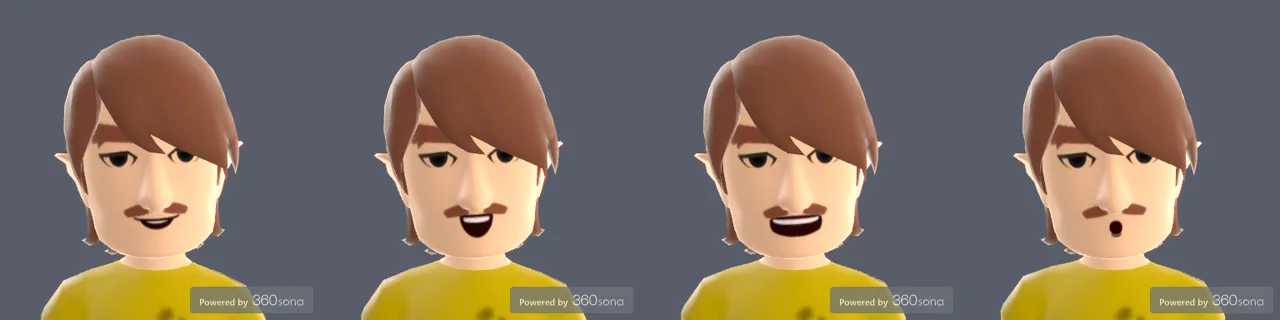
The mouth is the face's own speech shapes: SONA_MOUTH_O, _AI, _EE, _FV, _W, _L, _DTH and the shut
SONA_MOUTH_NEUTRAL, set with sona_avatar_mouth, which changes only the mouth and leaves eyes and brows to the clip
or to sona_avatar_expression. Every frame also carries eight weights (neutral and the seven shapes, summing to 1) and
an openness, for engines that blend shapes on their own rig.
Speaking a stream
sona_lipsync_options o;
sona_lipsync *ls;
sona_lipsync_defaults(&o);
o.sample_rate = 48000;                 /* any rate from 8 to 192 kHz */
o.channels = 2;                        /* interleaved; averaged to mono */
o.format = SONA_PCM_S16;               /* or SONA_PCM_F32 */
sona_lipsync_create(&o, NULL, &ls);    /* NULL allocator: malloc */

/* each audio callback or game frame, whatever the chunk size: */
sona_lipsync_feed(ls, samples, frames);
sona_lipsync_frame f;
sona_lipsync_current(ls, &f);
/* the same shape again costs nothing */
sona_avatar_mouth(avatar, f.mouth);

sona_lipsync_destroy(ls);
sona_lipsync_options o;
sona_lipsync *ls = nullptr;
sona_lipsync_defaults(&o);
o.sample_rate = 48000;                 // any rate from 8 to 192 kHz
o.channels = 2;                        // interleaved; averaged to mono
o.format = SONA_PCM_S16;               // or SONA_PCM_F32
sona_lipsync_create(&o, nullptr, &ls); // no allocator: malloc

// each audio callback or game frame, whatever the chunk size:
sona_lipsync_feed(ls, samples, frames);
sona_lipsync_frame f;
sona_lipsync_current(ls, &f);
// the same shape again costs nothing
sona_avatar_mouth(avatar.raw(), f.mouth);

sona_lipsync_destroy(ls);
// any rate from 8 to 192 kHz; interleaved, averaged to mono
using var ls = new SonaLipSync(48000, 2);

// each audio callback or game frame, whatever the chunk size:
ls.Feed(pcm);                                // float samples
// the same shape again costs nothing
avatar.SetMouth(ls.Mouth(out float open));
// any rate from 8 to 192 kHz; 16-bit, interleaved, averaged to mono
let mut ls = LipSync::with_format(48000, 2, true)?;

// each audio callback or game frame, whatever the chunk size:
ls.feed_i16(samples)?;
avatar.set_mouth(ls.current().mouth as u8)?;
// the same shape again costs nothing
# any rate from 8 to 192 kHz; interleaved, averaged to mono
ls = sona.LipSync(48000, channels=2, s16=True)

# each audio callback or game frame, whatever the chunk size:
ls.feed(samples)
# the same shape again costs nothing
avatar.mouth(ls.current().mouth)

ls.close()
The analyser needs no ctx and no thread: one per speaker, on any thread (one thread at a time per analyser). It makes
a frame for every 10 ms of audio; sona_lipsync_read hands over every frame since the last read (the newest 256 are
kept), for an offline render at any frame rate, and sona_lipsync_current the newest. The frames are the same for the
same samples however they are chunked (one sample at a time, 480, or the whole clip), and the same bits on every
platform, little- or big-endian, 32- or 64-bit: only + - * / and sqrt are used, with the core's own tables, exp
and log.
The analysis window is 30 ms long and each step 10 ms long, so sona_lipsync_latency is 25 ms: half the window
and one step, at the sample rates of 8, 16, 44.1 and 48 kHz.
The analysis runs on the thread that feeds it, a step at a time; the talking crowd below shows what the mouths cost.
How it decides
It starts from the web SDK's microphone mode: loudness against a running noise floor and speech peak
opens the mouth, and the energy in three bands picks the shape. The default mode measures these its own way, on a
window set to 30 ms, every 10 ms, with a -55 dB gate and smoothing (below). SONA_LIPSYNC_WEB_RULES runs the demo itself
instead (next section). On top of the demo's idea, the default mode adds:
- Vowels by formants. An LPC envelope (order 10, from the power spectrum up to a cutoff of 5 kHz, so any sample rate gives the same model) finds F1 and F2, and the nearest vowel regions pick the shape: /a/ and /ae/ AI, /i/ and /e/ EE, /o/ O, /u/ (and the fronted /u/ of American English) W, the central vowels L. A higher F1 opens the jaw wider.
- Higher voices. The speaker's pitch (subharmonic summation, a running mean in octaves) scales the vowel regions: a high voice's formants sit higher than a low voice's for the same vowel.
- Closed lips. A nasal murmur (almost all its energy under a cutoff of 400 Hz) shuts the lips at once, so the M in "my" closes the mouth instead of flapping it open.
- Fricatives. Hiss above a cutoff of 3.5 kHz shows FV when it is quiet (f, v, th) and DTH when it is loud (s, sh, z), even when it is too quiet to open the mouth.
- Smoothing. Openness and weights rise in
attack_seconds(20 ms) and fall inrelease_seconds(70 ms); a shape holds at leasthold_seconds(70 ms), and the current shape keeps an edge (a threshold of 10%), so the face never flickers.
It works the same at sample rates of 8 to 192 kHz, on floats or 16-bit samples, and for low and high voices.
The web demo's rules (SONA_LIPSYNC_WEB_RULES)
With this flag the analyser is the demo's listen() over a Web Audio AnalyserNode (fftSize 1024,
smoothingTimeConstant 0.4), so a game can show the same mouths as the page:
- Every 50 ms (five steps, each set to 10 ms, of
round(rate / 100)samples), one tick over the last 1024 samples at any rate. - Loudness: the time-domain rms times 1.6. The floor moves by a fixed 10% toward a quieter tick and a fixed 0.2% toward a louder one,
from 0.01. The peak is the largest of the rms, the peak times 0.995 and four times the floor, from 0.05. Openness
is
(rms - 1.6 floor) / (peak - 1.6 floor), clamped to 0..1. There is no gate and no smoothing. - The spectrum is the analyser's own: a Blackman window,
|X| / 1024smoothed over ticks (0.4 of the last and 0.6 of the new), and power summed over binsfloor(lo / hz)up toceil(hi / hz)for 150-900, 900-2500 and 3500-8000 Hz, where hz is rate / 1024. - The table: shut under 0.12 open. If the high band holds over a threshold of 55% of the energy, FV (or DTH from 0.45 open). If mid is over 1.4 times low, EE (or L at 0.5 open or less). If mid is under 0.45 times low, O (or W at 0.55 open or less). Otherwise AI. The hold is 70 ms long: a new shape waits until more than that has passed since the last change.
- A frame every 10 ms of audio carries the last tick's result, timed at its end.
openis the tick's openness andVOICEDmeans the tick wanted a shape.hold_seconds,attack_seconds,release_seconds,gate_db,lead_secondsand hints do not apply.sona_lipsync_latencyis (512 + 5 steps) / rate: set to 60.7 ms at a sample rate of 48 kHz.
Under these rules native and the page's own JavaScript agree tick for tick on the shape, on VOICED and on the
openness, when both are fed the same samples. A browser's analyser computes in float32 and advances in 128-sample
render quanta, so in a browser a tick can see audio up to 128 samples older, and a band ratio within float rounding
of a threshold can go the other way.
Voice chat: a mouth from a level
When all a voice SDK gives you per remote player is a level (linear RMS; its scale does not matter, the state
learns it), keep one sona_voice_mouth per speaker:
sona_voice_mouth v[64];
for (i = 0; i < n; i++) sona_voice_mouth_init(&v[i],
    sona_avatar_id(avatars[i]));
/* each frame: */
uint32_t changed = sona_voice_mouths(avatars, v, levels, n, dt);
// sona.hpp has no wrapper for voice mouths: the C calls on the handles
std::vector<sona::Avatar *> talkers;    // the avatars in voice chat
float levels[64] = {};                  // each one's voice level this frame
sona_avatar *avatars[64];
sona_voice_mouth v[64];
uint32_t n = (uint32_t)talkers.size();
for (uint32_t k = 0; k < n; k++) { avatars[k] = talkers[k]->raw(); sona_voice_mouth_init(&v[k], sona_avatar_id(avatars[k])); }
// each frame:
uint32_t changed = sona_voice_mouths(avatars, v, levels, n, (float)dt);
// the avatars in voice chat
var talkers = new List<SonaAvatar> { avatar, other };
var v = talkers.Select(t => SonaLipSync.VoiceState(t.Id)).ToArray();
// each one's voice level this frame
var levels = new float[talkers.Count];
// each frame: the binding's raw call
var handles = talkers.Select(t => t.Handle).ToArray();
fixed (IntPtr* h = handles) fixed (Native.sona_voice_mouth* vp = v) fixed (float* lv = levels)
    Native.sona_voice_mouths(h, vp, lv, (uint)talkers.Count, (float)dt);
// the avatars in voice chat
let mut talkers = [avatar, other];
let mut v: Vec<VoiceMouth> = talkers.iter().map(|t| VoiceMouth::new(t.id())).collect();
// each one's voice level this frame
let levels = [0.0f32; 2];
// each frame: each talker's mouth from its level
for (k, t) in talkers.iter_mut().enumerate() {
    t.voice(&mut v[k], levels[k], dt as f32)?;
}
# the avatars in voice chat
talkers = [avatar, other]
v = [sona.VoiceMouth(t.id) for t in talkers]
# each one's voice level this frame
levels = [0.0] * len(talkers)
# each frame: each talker's mouth from its level
for t, vm, level in zip(talkers, v, levels):
    t.voice(vm, level, dt)
Loudness opens the mouth; the level rising out of a dip starts a syllable, which picks a shape from a sequence seeded
by seed and weighted by how wide the mouth opens (AI and O wide, EE, W and L in between, DTH and FV small). Two
talkers with the same voice do not move in step. The mouth shuts in a pause between syllables, a shape holds at
least hold_seconds, and a long vowel picks a new shape after a set interval of 220 ms.
sona_voice_mouth_step alone gives the shape and openness without an avatar, for a host rig. A step costs little more than the call: in C it is a few dozen flops. What costs on the avatar is the face: see below.
Text and TTS
- Phonemes as they play (
sona_lipsync_hint): when the TTS reports phonemes with times on the audio's clock, give them to the stream's analyser. A hint wins while the audio is sounding (M, B, P shut the lips at once), showslead_seconds(40 ms) before its sound, as lips move ahead of the voice, and the frame saysSONA_LIPSYNC_HINTED. - Timed phonemes to keys (
sona_lipsync_phonemes): a whole utterance's phonemes tosona_mouth_keys (time, mouth, open), with the lead, closures kept, shapes shorter than the hold merged, and the mouth shut over gaps. - Text to keys (
sona_lipsync_text): English spelling rules make the shapes (th, sh, ph, ee, oo, magic e, silent e, double letters), punctuation makes pauses, accented Latin letters take their vowel and other scripts a syllable a letter. With the audio, a Viterbi pass aligns the letters to the analyser's frames (open vowels on loud voiced frames, closures and pauses on quiet ones, the vowel's own formants as a cost), so each shape lands where it is said. Without audio, an even pace. Up to 4096 letters and the 10 minutes limit of audio; past 16 M frame-letter cells the text is paced over the sounding part instead. - Playing keys (
sona_mouth_keys_sample): the shape at time t, eased over a 50 ms interval, with weights.
Phoneme symbols (sona_phoneme_mouth): ARPAbet with or without stress digits (AH0), IPA in UTF-8 (ʃ, aɪ,
stress and length marks skipped), the 15 viseme names (sil, PP, FF, TH, DD, kk, CH, SS, nn, RR,
aa, E, ih, oh, ou), the 22 viseme ids as digits ("0" silence to "21" p b m), and the mouth names
themselves (AI, DTH, MBP, etc). Anything else is SONA_MOUTH_UNKNOWN.
On the avatar
sona_avatar_mouth(a, shape) sets the mouth part of the expression alone: a speech shape, any other shape index of
the face, or 255 to hand the mouth back to the clip (when nothing else is set, the whole face goes back). The face
sheet is baked again only when the shape changes. Each combination is baked once and kept in the face cache, so a
talking avatar costs a sheet copy per shape change, plus an upload when no other avatar already
shows that face. Avatars drawn as crowd sprites show no expressions.
On the GPU a re-baked face is keyed by its content (the look and the shapes), as the built face is. Avatars that show the same face share one texture, and one that changes its mouth moves to the texture of its new face. If no avatar shows that face, the texture it held is refilled when nothing else uses it, or a new one is made. So two players with the same look never show each other's mouths. A stock-look crowd needs one texture per face shown, not one per talker. An expression set after an avatar's first draw shows on the next frame.
The cost of a talking crowd, from lipsync_vk --crowd 100 on an RTX 4090 machine: 100 avatars of the cast, their
faces at the automatic size, 120 frames silent, then 120 with every avatar talking from a level and 120 silent again,
the frame updated, drawn and read back. The median of three runs:
lipsync_vk --crowd 100 |
ms a frame | of it, sona_update (ms) |
|---|---|---|
| Silent | 0.92 | 0.13 |
| Talking | 4.4 | 3.55 |
The crowd changed mouths 1,858 times in the sample's set 2 s of talking. Almost all of what talking adds is the update's face re-bakes on the CPU; the draw costs the same either way.
The renderers upload a face that was baked again after the avatar was first drawn. The sample checks this on the GPU: held still, shut then O then shut again must draw A, B, A exactly.
Bindings
- C#. Stream:
SonaLipSync(Feed,Read,Mouth,Hint,Latency). Keys:SonaLipSync.FromText,.Sample,.PhonemeMouth. Voice chat:SonaLipSync.VoiceState,Native.sona_voice_mouth_step. Avatar:SonaAvatar.SetMouth,.Voice. - Python. Stream:
sona.LipSync(feed,read,current,hint,latency). Keys:sona.lipsync_text,lipsync_phonemes,mouth_keys_sample,phoneme_mouth. Voice chat:sona.VoiceMouth.step. Avatar:Avatar.mouth,.voice. - Rust. Stream:
sona::LipSync(feed,feed_i16,read,current,hint,latency). Keys:sona::lipsync_text,lipsync_phonemes,mouth_keys_sample,phoneme_mouth. Voice chat:sona::VoiceMouth::step. Avatar:Avatar::set_mouth,::voice.
The sample
samples/c/lipsync_vk.c: an avatar speaking a WAV file (16-bit or float, any rate, 1 to 8 channels), drawn
headless with Vulkan at the face framing, every frame to PNG, plus a sheet with one cell per shape shown and
mouths.csv. The audio is fed in video-frame chunks, as a game would feed its voice stream; --text uses the
text aligned to the audio instead; --synth speaks a built-in synthesised line, so it runs without a file; --mouth
N holds one shape.
lipsync_vk --wav speech.wav [--text "what is said"] [--index 2] [--fps 30]
    [--size 384x384]
           [--out lipsync] [--every 1]
lipsync_vk --crowd 100 [--same] [--size 1280x720]
A twin with the same look stands beside the speaker. At the end, both go through five mouth steps side by side
(twins.png). --crowd N times a talking crowd instead (see "On the avatar").
It fails when fewer than three shapes show, when the drawn mouth does not follow sona_avatar_mouth, or when the twin
shows a mouth that is not its own.
Reference
| Function | Contract |
|---|---|
sona_lipsync_defaults(o) |
48 kHz, 1 channel, float, hold 0.07, attack 0.02, release 0.07, gate -55 dB, lead 0.04; sets size |
sona_lipsync_create(o, al, out) |
NULL o: the defaults; NULL al: malloc. SONA_E_ARGUMENT for a short size, a rate outside 8000..192000, channels outside 1..8, another format, times out of range (hold 0..1, attack 0..1, release 0..2, lead 0..0.5 s, gate -120..0 dB), NaN, unknown flags or non-zero reserved words |
sona_lipsync_destroy(ls), sona_lipsync_reset(ls) |
reset: time 0, frames and hints dropped, the floor and the speaker's pitch learnt again |
sona_lipsync_feed(ls, pcm, frames) |
frames are samples per channel; non-finite or out-of-range float samples count as 0. SONA_E_ARGUMENT for NULL ls, or NULL pcm with frames |
sona_lipsync_read(ls, out, max) |
moves up to max frames, oldest first; returns how many |
sona_lipsync_current(ls, out) |
the newest frame; a shut mouth at time 0 before the first |
sona_lipsync_latency(ls) |
(window / 2 + step) / rate, by default 25 ms; with SONA_LIPSYNC_WEB_RULES (512 + 5 steps) / rate |
sona_lipsync_hint(ls, ph, count) |
unknown symbols and empty spans are skipped; up to 256 held, the oldest go; hints that ended a second before the newest frame go |
sona_phoneme_mouth(symbol) |
SONA_MOUTH_*, or SONA_MOUTH_UNKNOWN (255) |
sona_lipsync_phonemes(ph, count, o, out, cap, total) |
phonemes in start order (SONA_E_ARGUMENT otherwise, or for an end before its start); *total keys, up to cap written; the same total for any cap |
sona_lipsync_text(text, pcm, frames, o, out, cap, total) |
pcm in o's rate, channels and format; SONA_E_LIMIT past 4096 letters or the 10 minutes limit |
sona_mouth_keys_sample(keys, count, t, out) |
before the first key and with no keys: shut |
sona_avatar_mouth(a, shape) |
SONA_E_ARGUMENT for a shape past 13 that is not 255, SONA_E_DESTROYED for a removed avatar |
sona_voice_mouth_init(v, seed), sona_voice_mouth_step(v, level, dt, open) |
dt clamped to 0..1 s, a NaN or negative level counts as 0; returns SONA_MOUTH_NEUTRAL for a state that was not initialised |
sona_avatar_voice(a, v, level, dt), sona_voice_mouths(avatars, states, levels, count, dt) |
the step, then sona_avatar_mouth; the batch skips NULL avatars and returns how many mouths changed |
Structs: sona_lipsync_options (64 bytes, size first), sona_lipsync_frame (72), sona_phoneme (16, 12 on
32-bit), sona_mouth_key (16), sona_voice_mouth (56, size first), and the opaque sona_lipsync.
sona_struct_size and sona_struct_offset know them.
Limits
- The WASM binding, the C++ header and the engine components (Unity, Unreal, Godot) do not wrap these calls; call the C functions.
- The web SDK's mouths are its own JavaScript.
SONA_LIPSYNC_WEB_RULESmakes the native analyser give the web's mouths tick for tick, so a native server and a web client agree. - A talking crowd's cost is the CPU re-bake of each face that changes (above).
- The baked face has discrete shapes, so the mouth switches rather than blends; the weights are there for rigs that can blend.
- Speaker normalisation uses pitch alone; a child's or a very low voice is read with the nearest scale.
This page as Markdown · All the docs as one file (llms-full.txt)